

09 Nov How to Get a Face Fit Certificate in the UK – Face Fit Testing & Training Explained
If you wear a tight-fitting respirator for work, or you’re responsible for ensuring employees are adequately protected, you may have come across the requirement for a face fit certificate.
But what exactly is a face fit certificate, how do you obtain one, and what training is required if you want to carry out face fit testing yourself?
At Training & Testing Services (TTS), we specialise in face fit testing and Face Fit Train the Tester training. Here, we explain the differences and help you identify the right option for your needs.
What Is a Face Fit Certificate?
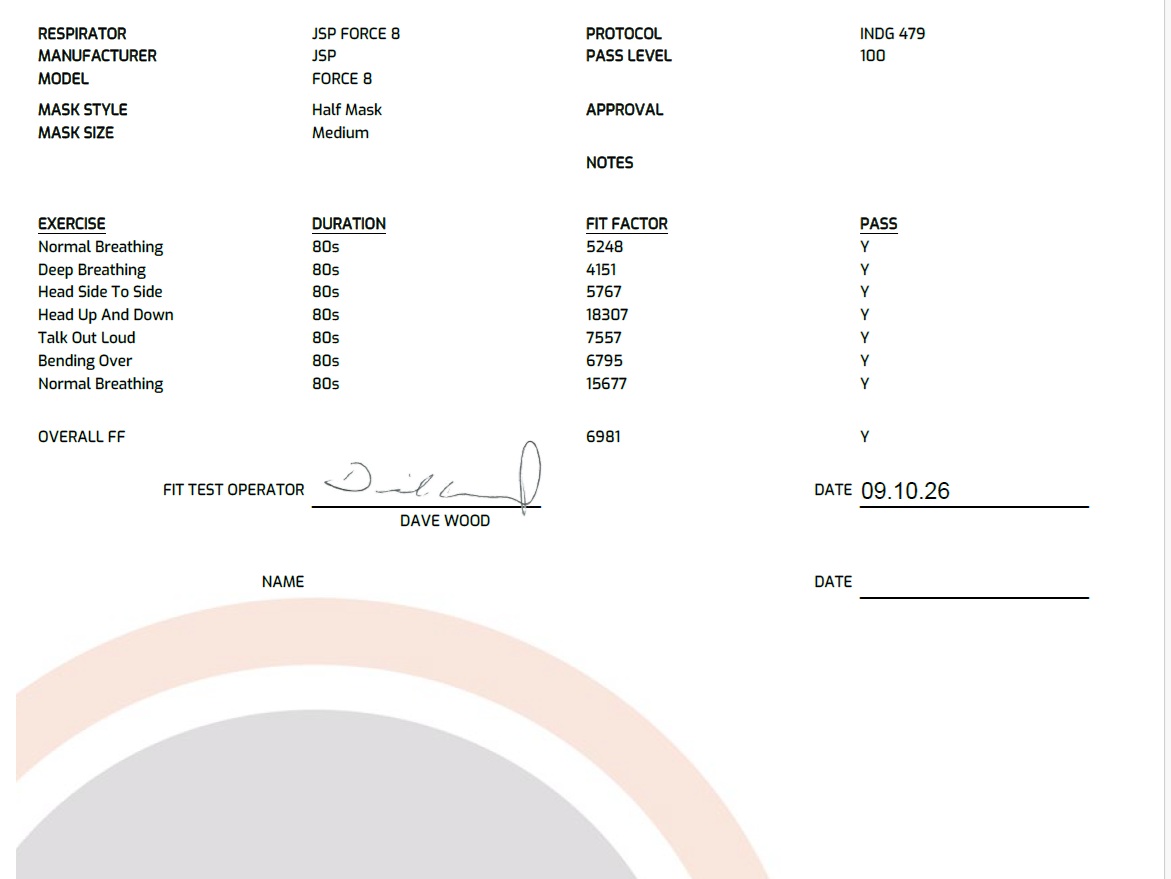
A face fit certificate is commonly used to describe the record issued following a successful respiratory protective equipment (RPE) face fit test.
The test checks whether a particular make, model and size of tight-fitting respirator provides an adequate seal against the wearer’s face.
Face fit testing is important for anyone required to wear tight-fitting respiratory protection, including FFP3 disposable masks, reusable half masks and full-face respirators.
A successful face fit test demonstrates that the particular respirator tested provides an adequate fit for that individual at the time of testing.
How Do I Get a Face Fit Certificate?
To obtain a face fit certificate, you need to undergo a face fit test conducted by a competent face fit tester.
During the test, the tester will assess whether your chosen respirator provides an adequate seal using an appropriate testing method.
There are two main methods of face fit testing:
Qualitative Face Fit Testing
Qualitative testing uses a bitter or sweet-tasting solution to determine whether the wearer can detect leakage into the mask.
This method is suitable for disposable respirators, including FFP3 masks, and certain reusable half masks.
Quantitative Face Fit Testing
Quantitative testing uses specialist equipment to measure the effectiveness of the seal between the respirator and the wearer’s face.
It provides a numerical result known as a fit factor and can be used for disposable respirators, reusable half masks and full-face respirators.
Following a successful test, a record of the result can be issued.
How Do I Become a Face Fit Tester?
If you’re responsible for health and safety within your organisation, regularly arrange face fit testing for employees, or want to offer face fit testing as a service, completing a Face Fit Train the Tester course may be the appropriate option.
The Health and Safety Executive (HSE) requires face fit testing to be carried out by a competent person with the appropriate training, knowledge and experience.
A Face Fit Train the Tester course provides the theoretical knowledge and practical instruction needed to develop competence in conducting face fit tests.
Training typically covers:
- The importance of respiratory protection and correct mask selection
- Relevant HSE guidance and face fit testing requirements
- Qualitative or quantitative testing methods
- Correct preparation and use of testing equipment
- Conducting face fit tests and interpreting results
- Identifying potential causes of test failure
- Recording and reporting test results
Completing a training course is an important step towards becoming a competent face fit tester, although practical experience and ongoing competence are also essential.
What Is the Difference Between Qualitative and Quantitative Face Fit Training?
The appropriate training depends on the type of respirators you intend to test and the testing method you wish to use.
Qualitative Face Fit Train the Tester
Suitable for those intending to test disposable respirators, such as FFP3 masks, and reusable half masks using a taste-based testing method.
Quantitative Face Fit Train the Tester
Suitable for those intending to use specialist equipment to measure face fit. This method can be used for disposable respirators, reusable half masks and full-face respirators.
At Training & Testing Services, we offer both qualitative and quantitative Face Fit Train the Tester training.
Do I Need to Be Fit2Fit Accredited to Carry Out Face Fit Testing?
Fit2Fit is the accreditation scheme developed by the British Safety Industry Federation (BSIF) to help demonstrate the competence of individuals carrying out respiratory protective equipment fit testing.
Although Fit2Fit accreditation is not a legal requirement, it is a recognised way of demonstrating competence.
It is important to understand that completing a Face Fit Train the Tester course does not automatically make you Fit2Fit accredited. Accreditation involves a separate assessment process.
Training & Testing Services is a Fit2Fit-accredited face fit testing provider, and our Face Fit Train the Tester courses are Fit2Fit approved.
Where Can I Attend a Face Fit Training Course?
Training & Testing Services offers Face Fit Train the Tester open courses at our training centres in:
Knaresborough, North Yorkshire – Convenient for delegates travelling from Harrogate, York, Leeds and surrounding areas.
Morden, South London – Convenient for delegates travelling from London and surrounding areas.
Our courses are designed for individuals and organisations looking to develop the skills required to conduct face fit testing.
Whether you’re looking for qualitative or quantitative training, our team can help you identify the most suitable course.
Book Your Face Fit Train the Tester Course
If you’re looking for face fit testing training in Yorkshire or London, Training & Testing Services can help.
We provide specialist training delivered by experienced trainers, with practical instruction to help delegates develop the knowledge and skills required to conduct face fit testing.
Contact Training & Testing Services today to discuss your requirements or book a place on one of our forthcoming Face Fit Train the Tester courses.
Telephone: 01423 611030
Visit our website to view upcoming course dates and availability.

No Comments